There Are Four Stages of AI Maturity. The Real Gap Is Between Your Teams' Current Knowledge and What They Are Capable Of.
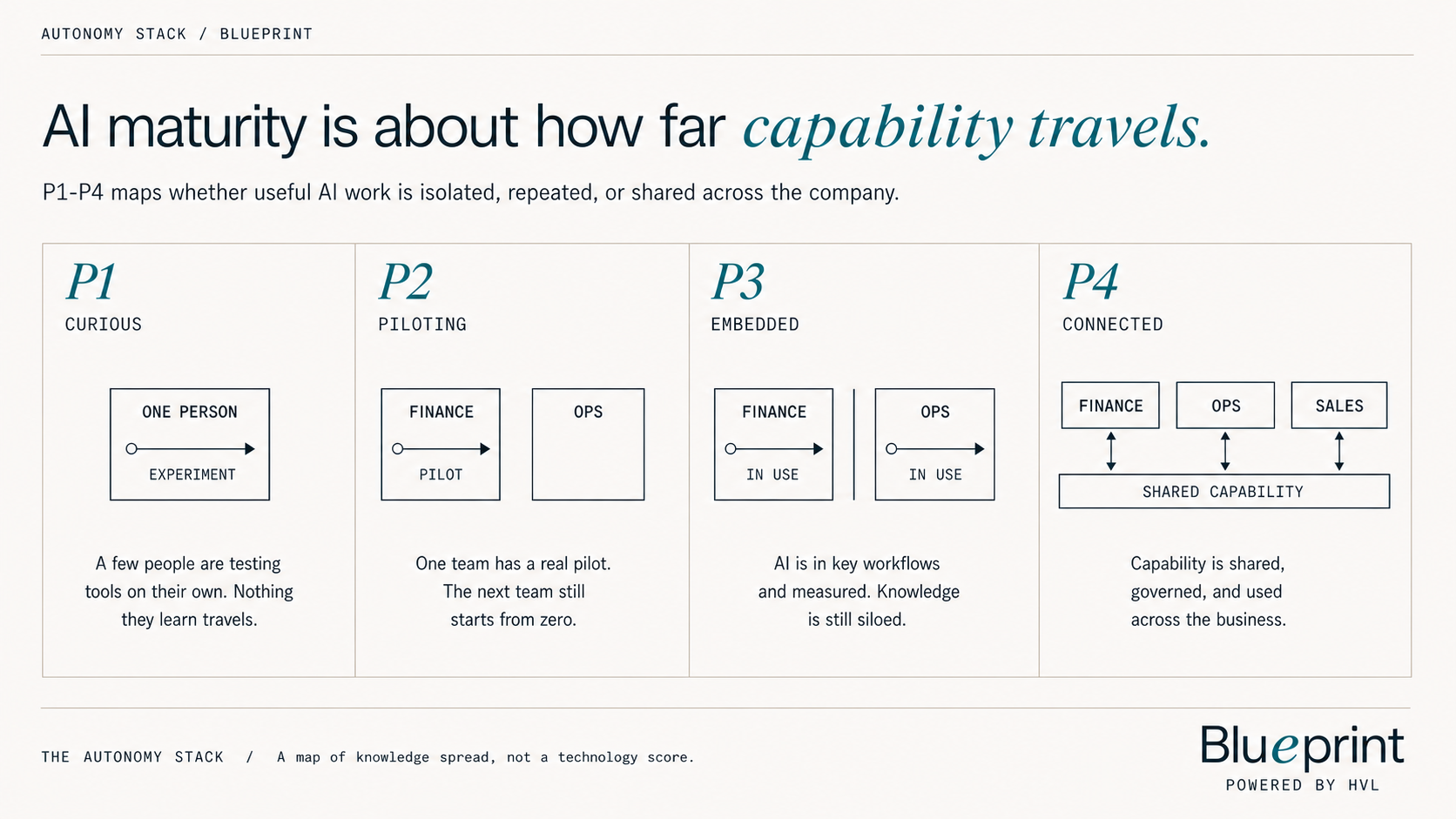
What is AI maturity? AI maturity is the extent to which useful AI capability is visible, repeatable, and shared across a business. HVL's Autonomy Stack maps that progression from isolated experimentation to connected capability.
The four stages of AI maturity
Curious
A few people are experimenting on their own. Nobody else knows, and nothing they have learned has traveled.
Piloting
Real skill now lives inside individual teams, but it is contained. The team next door starts from zero.
Embedded
Capability is owned and measured, but still siloed. What Finance figured out has not reached Operations.
Connected
What individuals learned is now how the company works. Capability is shared, governed, and used across the business.
Walk into almost any company right now and you will find someone who has already figured out something real with AI, on their own, without asking anyone's permission. Walk three departments over and you will find people who have never touched it. The issue is not a lack of activity. It is that a handful of people have made progress and the rest of the business has not had a clear way to build on it.
We call the distance between those two ends of the company the Autonomy Stack, four stages, P1 through P4. It is a map of where capability has permeated your business and insight into how to bridge the gap. Most companies sit across more than one stage, with real skill in one area and room to build on it elsewhere.
Why useful work needs a path to spread
The problem is rarely whether one person can make AI useful. It is whether the company can recognize that work, connect it to a live workflow, and give the next team a way to build on it.
RAND's 2025 research into failed AI projects makes the cost of that gap clear. More than 80% fail. After speaking with 65 data scientists and engineers, RAND found the causes were organizational: unclear definitions of success, weak data foundations, and projects that remained with one person or team rather than moving into the business.
That is why the returns still lag behind the activity. Only 25% of AI initiatives have delivered the ROI CEOs expected, according to IBM's 2025 CEO Study. McKinsey's November 2025 State of AI survey found that 39% of organizations can attribute any EBIT impact to AI, and most of those organizations report an impact under 5%.
Progress builds when useful work is visible, documented, and shared. The people closest to the work can help the rest of the business build on what already works.
Build from the capability already inside your company
The smarter path starts inside the building: identify the people who have already made progress, understand the workflow behind it, and give other teams a clear way to apply it. That is upskilling, a practical way to turn isolated progress into a shared way of working.
Blueprint starts by showing, department-by-department, where capability is already taking hold and how each team can build on it.
Frequently asked questions
What is an AI maturity assessment?
An AI maturity assessment gives leadership a shared view of where AI is already useful, where work is stalled, and what needs to change for capability to spread. Blueprint uses the Autonomy Stack alongside department-level input to identify where to focus.
What does AI maturity measure?
AI maturity measures how widely useful capability has spread through the company. It looks beyond tool adoption to whether teams can repeat, share, and apply useful work in their day-to-day workflows.
Why do AI pilots fail to spread?
Pilots often remain inside one team because the business has not defined success clearly, connected the work to a live workflow, or given other teams a way to build on what was learned.
Sources
- RAND Corporation, James Ryseff et al., Why AI Projects Fail and How They Can Succeed, 2025.
- IBM Institute for Business Value, 2025 CEO Study, May 6, 2025.
- McKinsey & Company, The State of AI: How Organizations Are Rewiring to Capture Value, November 5, 2025.