What Does a Venture Studio Do? Research, Validate and Build

Image: AI-edited composite based on a Venture Yards photograph by Liesa Cole.
A venture studio creates new companies by helping identify a customer problem, test whether a business can be built around it, and assemble the product and team to launch. Studios often participate as owners and investors, although their funding and operating models vary.
For an established business, the starting point may be something its leaders already see: customers struggling with the same task, an underserved market, or a capability that could become a separate business.
Seeing the opportunity is only the beginning. Someone has to determine whether customers will pay, whether the business can serve them profitably, and who will be responsible for building it.
That is the work a venture studio takes on. At Harmony Venture Labs, we pair that company-building work with venture capital. We help established companies research and test a new business opportunity, then co-build and co-invest when it earns a green light.
For a business owner, that means working with a partner that contributes both the team to build and capital at risk alongside yours.
How is a venture studio different from venture capital or an accelerator?
Venture studios and venture capital firms describe different roles, and one organization can perform both. A studio helps create and operate a new company. A venture capital firm invests in companies in exchange for ownership. HVL combines those roles.
The useful distinction is what each partner takes responsibility for:
| Model | Typical starting point | Primary contribution |
|---|---|---|
| Venture studio | A problem, opportunity or early company concept | Helps create the company through research, testing and hands-on building; often holds equity |
| Venture capital firm | A founding team seeking investment, sometimes before a product exists | Provides capital and may support recruiting, strategy and introductions |
| Accelerator | An existing founding team developing a business | Runs a structured program with mentorship, connections and sometimes investment |
| Product development firm | A defined product need or build brief | Designs and develops the product under an agreed scope |
| HVL’s combined model | An opportunity to build a new business alongside an established company | Researches and tests the opportunity, then co-builds and co-invests when the venture is greenlit |
Before choosing a partner, ask who will test demand, who will recruit the company’s leadership, and who stays responsible after the first product launches. A prototype alone does not answer those questions.
How HVL brings company building and venture capital together
At HVL, the studio does the work of developing a business: identifying the customer problem, testing demand and building the product and team. The HVL-Innovate Fund provides a path to co-investment in the ventures we launch with corporate partners in Alabama.
Those roles connect around the same decision: does the evidence justify building and investing in this company?
Research comes first. An initial idea does not carry an automatic investment commitment. We test the opportunity before deciding whether to move forward. When a venture is greenlit, we co-invest through the fund and build alongside the partner.
That gives the relationship a shared financial stake. We take on building responsibilities and put capital at risk. Our return as an investor depends on the company creating value over time.
For an established business, the combination brings dedicated company-building capacity and an investment partner into the same process. Your industry knowledge and customer relationships help shape the opportunity. Together, we determine whether it deserves a company and commit resources to building it.
Research: find the problem worth building around
Research begins with the people experiencing the problem and the people who would pay to fix it. They may be different people.
A business owner might see employees repeating a manual task and assume that other companies would buy software to handle it. That is a reasonable starting hypothesis. Research needs to establish how widespread the task is, what it costs, and why existing products have not addressed it.
Useful questions include:
- How does the customer handle this today, and what breaks?
- How often does the problem occur?
- Who owns the budget and the decision to change?
- What would prevent the customer from adopting a different approach?
Existing workarounds matter. Spreadsheets, extra staff and outsourced services show how customers currently spend time or money. They also reveal what a new business would have to replace.
The result should be a specific opportunity: a defined customer, a recurring problem and evidence that the problem matters. A broad claim that an industry is ready for AI is not enough.
Validate: test the assumptions before committing to a company
Validation asks whether the opportunity can support a business.
A customer saying an idea sounds useful is an early signal. A customer agreeing to test it in a real workflow, involving the budget owner or paying for a pilot provides different evidence. Each commitment helps answer a particular question; none guarantees a successful company.
Consider an illustrative example: a distributor sees repeated order-entry errors among its customers and proposes an AI product to reduce them.
The first test might handle one type of order for a small group of users. It would need to show whether the product reduces errors, whether someone trusts it enough to use it, and whether the benefit justifies the cost of adoption. Building a full platform before answering those questions would add expense without resolving the uncertainty.
A useful validation plan names the assumption, the test and the decision it will inform.
| Assumption | Possible test | Decision it informs |
|---|---|---|
| The problem is frequent and costly | Observe the workflow and examine actual error or labor costs | Is this problem worth pursuing? |
| Customers will change how they work | Run a limited test with real users | Can the product fit into daily operations? |
| A buyer will fund it | Discuss a specific paid offer with the decision-maker | Is there a credible commercial path? |
Stopping is a valid outcome. If the problem is rare, a suitable product already exists, or adoption costs exceed the benefit, the evidence may support buying an existing tool or ending the project.
Build: turn the evidence into an operating business
Once the opportunity earns a build decision, the work expands beyond the product.
The company needs leadership, a way to reach customers and a commercial model. Someone must own implementation and support. Product decisions need to reflect what early customers actually use and pay for.
The first release should be narrow enough to test the business’s central promise. The team then uses customer behavior to decide what deserves further investment.
For a corporate partner, governance matters early. Who owns the intellectual property? Who makes product and hiring decisions? What happens if the partner’s priorities change? These questions belong in the partnership discussion before a growing company depends on informal agreements.
AI can make prototyping and some research tasks faster. It does not establish demand, confer permission to use customer data or remove the need for someone to own the result.
What does an established company bring to the partnership?
An established company can bring industry knowledge, access to customers and a close view of problems that outsiders would miss. A studio contributes a dedicated team and a process for testing and building a new business.
Both sides need to participate. Customer access is useful only if the team can speak with the right people. Executive sponsorship matters when a test requires operational cooperation or a decision about resources.
The early conversation should clarify what the partner can contribute, who can make decisions and what evidence would justify the next commitment.
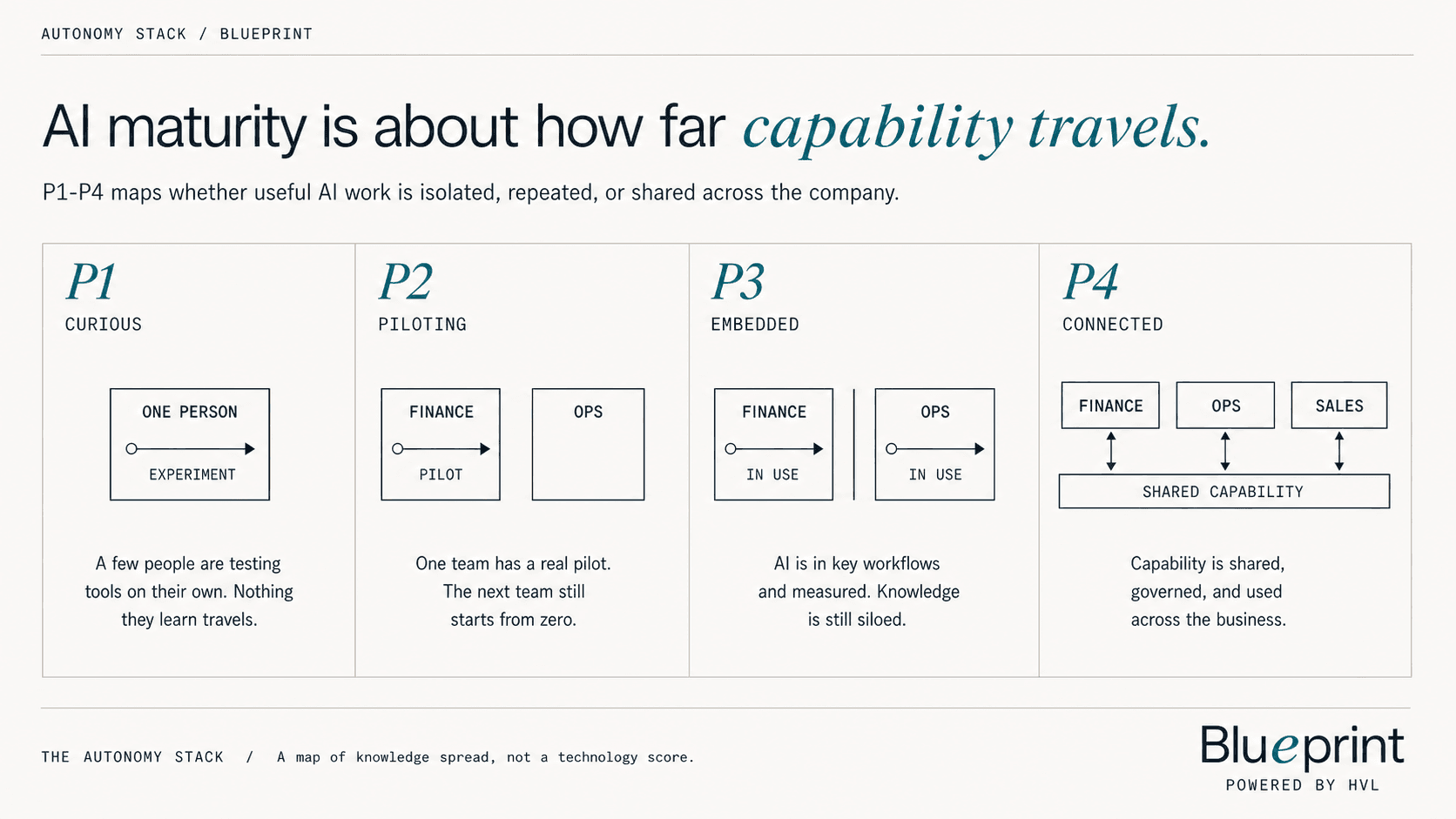
At Harmony Venture Labs, we build from internal ideas and alongside established companies. Our process connects discovery and focused tests to a build and investment decision, followed by product, team and go-to-market work. The studio and fund support the same goal: building a company that can earn customers and create lasting value.
When should you work with a venture studio?
A studio is worth considering when you see a potential new business but still need to establish the customer, commercial model and team required to build it.
Other situations call for a different approach. A well-defined software project may need a development partner. Improving an internal workflow may be an implementation project. A team with validated demand and an established operating plan may primarily need capital.
Before engaging a studio, ask:
- What evidence would cause you to recommend that we stop?
- What work will your team own, and what will ours need to contribute?
- How are investment, equity, intellectual property and decision rights handled?
- Who remains involved after launch, and what determines the next investment?
The answers should make the work and responsibilities clear. A credible partner should be able to explain how an uncertain opportunity becomes a decision, and how a supported decision becomes a company.
HVL brings company builders and investment capital to that process. If you see an opportunity to build a new business inside or alongside yours, we can start by testing whether it is worth pursuing together.
Ready to talk? This starts with a conversation, one founder to another. No pitch, no pressure.